Local water
What the village water report says about your tap
Buffalo Grove drinks Lake Michigan water that the village buys from the Northwest Water Commission. The village's 2022 water quality report lists hardness between 120 and 130 mg/L as calcium carbonate.
The USGS calls 61 to 120 mg/L moderately hard and 121 to 180 mg/L hard. That puts the reported range at the edge between the two classes, which is enough to leave scale on fixtures and inside a water heater over time.
Your own tap can read differently from a report average. Newer village reports may also differ from the 2022 one, so check the latest and consider testing your own water before sizing a unit.
Signs that point to hard water
Hardness is dissolved calcium and magnesium. When the water is heated or evaporates, it leaves a solid behind.
Crust on faucets and showerheads
White or chalky buildup around aerators and spray holes. Flow drops as the holes narrow.
Film on glass and tile
Cloudy glasses from the dishwasher and a soap scum ring that comes back a day after cleaning.
Scale in the water heater
The USGS notes that heated hard water forms deposits that can lower the efficiency of electric heaters, raise heating cost and shorten equipment life. A rumbling tank is one common clue.
Slow flow in older pipe runs
Deposits can narrow pipes and reduce flow. A plumber can tell scale from a different restriction by looking at the run.
None of these proves the water is the cause. A plumber confirms by checking the fixtures and, where useful, the water itself.
How a softener installation goes
The order matters because the drain and the bypass decide where everything else goes.
Walk the basement or utility room
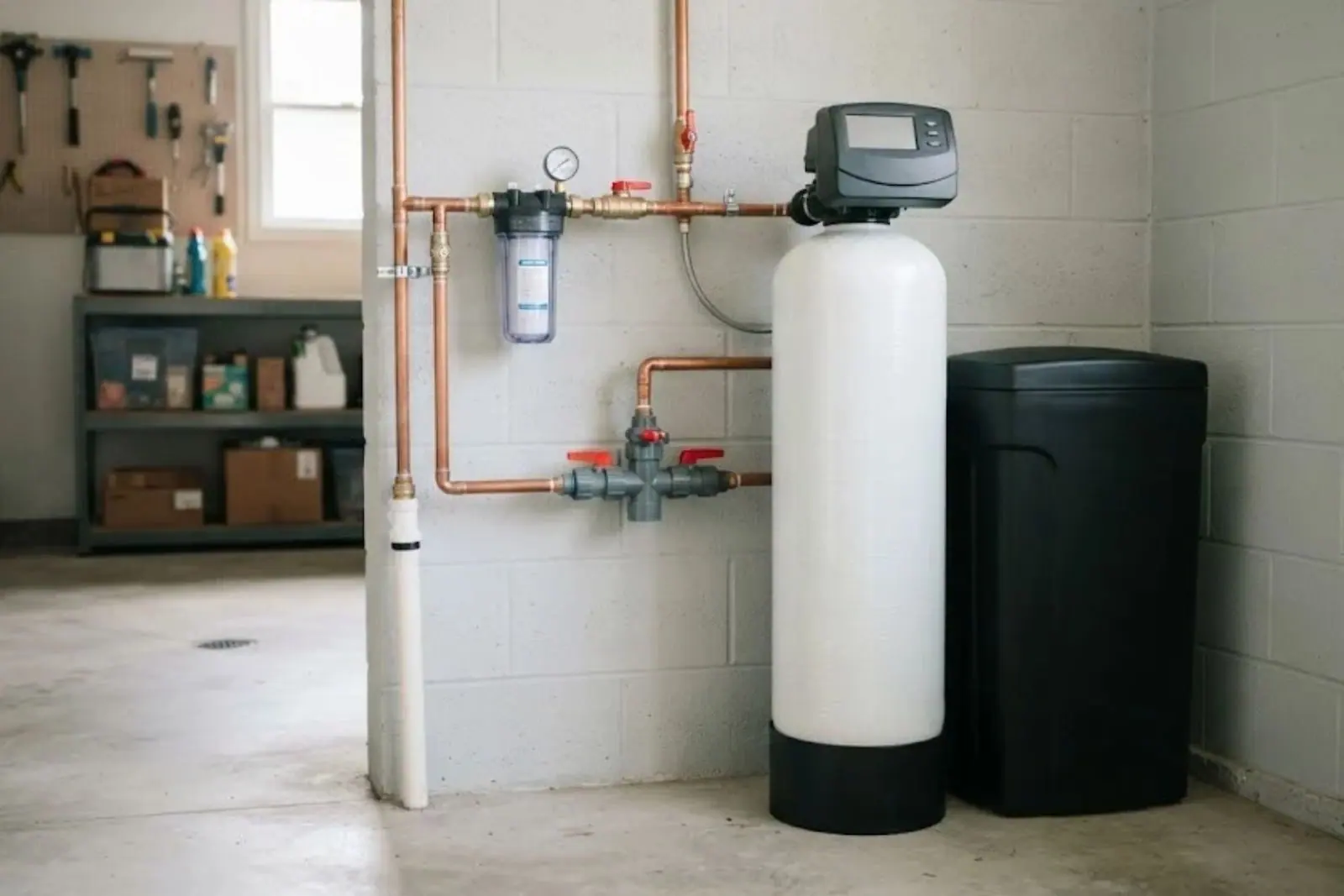
The plumber finds the main cold line after the meter, the nearest floor drain or laundry standpipe, a 120 volt outlet, and enough clear floor for the tank and brine tank.
Confirm what you already bought
Some people arrive with the tanks already purchased. Bring the model name and manual so the plumber can check the connection size and drain requirements before cutting pipe.
Shut off, cut in and plumb the bypass
The water is shut off at the main, the cold line is cut, and the unit is piped in with a bypass so you can isolate it later for service.
Run the drain and overflow
The regeneration line and the brine tank overflow need a proper air gap and a route to a drain. A hose pushed loosely into a standpipe is how basements get wet.
Start up and test
The plumber purges air, checks every joint for drips, sets the hardness input, and runs a regeneration cycle while watching the drain.
Hot water lines are usually left on the softened side, while many households leave outdoor hose bibs on the hard side so lawn water is not wasted on softening. Ask about that split during the walk-through.
What drives the price of a softener install
We give you the price before work starts. These are the things that move it up or down.
Salt, brine and where the water goes
A cation exchange softener removes hardness and then regenerates with salt. The EPA WaterSense guide notes that regeneration discharges salts and uses water, so a softener is not free of tradeoffs.
That discharge reaches the local wastewater system, and the guide adds that some jurisdictions restrict these units. Ask the village Community Development office at 847-459-2530 whether anything applies to your address before you buy.
A right-sized unit regenerates on demand rather than on a fixed schedule, which cuts salt and water use. Ask the plumber how the controller you chose decides when to regenerate.
Softener, filter or both
Softeners and filters solve different problems, and people often need only one.
| Goal | What usually fits | Notes |
|---|---|---|
| Scale on fixtures and in the heater | Cation exchange softener | Treats hardness only |
| Chlorine taste or smell | Carbon filter | Does not soften |
| Drinking water at one tap | Under-sink reverse osmosis | Needs a drain saddle and a small tank |
| Sediment or particles | Whole house sediment filter | Cartridges need regular changes |
| Hardness plus taste | Softener with a carbon stage | Plan the space for two tanks |
Chlorine is the disinfectant listed in the village's 2022 report, which is why carbon filtration comes up often.
Planning a softener or a filter?
Call (847) 281-8626 and describe the space, and we will explain the job and the price first.
Filtration beyond the softener
Whole house filtration, a kitchen reverse osmosis faucet and a sediment stage all tie into the same cold line a softener uses. Planning them together saves cutting the pipe twice.
The village's 2022 report also mentions lead from service lines and home plumbing as a possible source. A softener does not address lead, so if that is your worry, ask the plumber about testing and about what filtration is actually certified for.
Repairs, valves and softeners that stopped working
Not every call is a new install. Common ones include a broken control valve after a move, a regeneration line cut during remodeling, and a unit that no longer regulates the water.
A plumber checks the bypass, the drain line and the brine tank first. If a softener overflows, shut the bypass, unplug the unit and call. Leaks from a tank connection are covered by leak detection when the source is not obvious.
Nearby work that often comes with a softener
A softener install is a good time to look at an aging water heater, since scale has been working on it. It is also when other new fixture hookups are easiest to add.
We cover Wheeling, Arlington Heights, Lincolnshire and Deerfield as well. See the full services list or the service area page for details.
Where the facts on this page come from
The hardness range comes from the Village of Buffalo Grove 2022 water quality report. The hardness classes come from the USGS, and the notes on regeneration and salt discharge come from the EPA WaterSense home water treatment guide.
Permit information comes from the village Community Development office. Illinois plumbers are licensed by the Illinois Department of Public Health, and you can check any plumber through the IDPH online license verification before work starts.
Questions we hear from homeowners
The village's 2022 water quality report lists hardness between 120 and 130 mg/L. By USGS classes that sits at the edge of moderately hard and hard.
Test your own tap, since a report gives an average.
Yes, if the plumber can confirm the connection size and drain needs from the model. Bring the manual and model name to the call.
Regeneration uses water and discharges salts, according to EPA WaterSense. How much depends on the unit and how it decides when to regenerate.
No. A softener treats hardness. Chlorine taste is handled by a carbon filter or a reverse osmosis tap.
Plumbing work beyond maintenance, servicing or repairs needs a permit in Buffalo Grove. The plumber will tell you whether your job does.
Yes. The plumber checks the bypass, drain line, brine tank and control valve. Some failures follow remodeling or a move.
It depends on the drain distance, pipe material, add-on filters and permit need. You get a clear price before work starts.
Put it on bypass, unplug it and call (847) 281-8626. The line is answered around the clock.