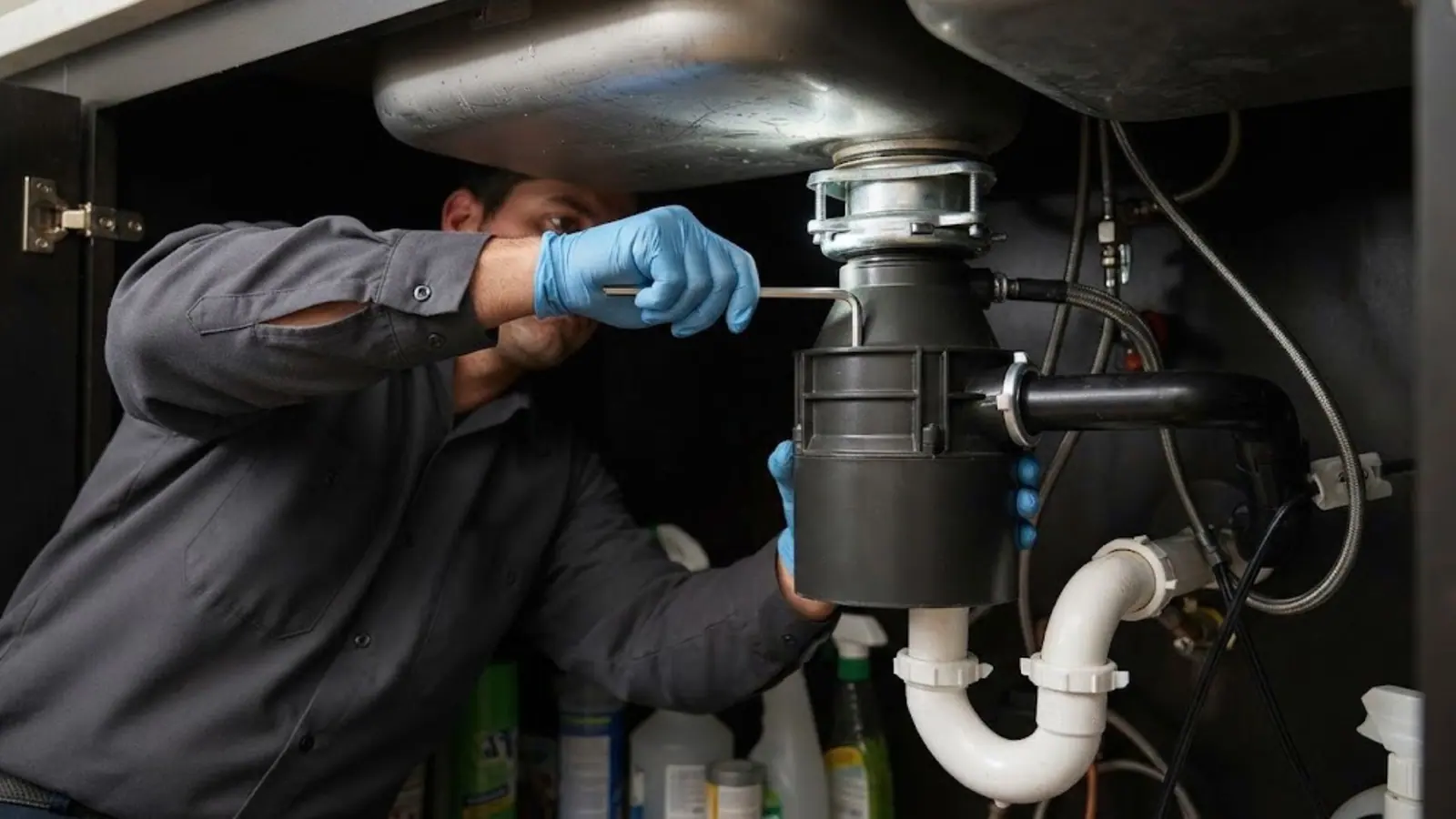
What to do if the disposal is leaking or backing up right now
Water under a sink can reach the cabinet floor and the wall quickly, and a disposal that is jammed is a hazard to hands.
Safe steps while you wait
- Turn the disposal off at the switch, then unplug it or flip the breaker.Make sure it cannot start while anyone is working near it.
- Never put a hand in the disposal.Not to free a jam and not to retrieve a spoon. The blades or impellers can injure even when the unit seems dead.
- Stop running the sink and dishwasher.Both drain through the same connection, so more water just adds to the overflow.
- Close the sink supply stops if the leak is above the disposal.Shut the two small valves below the sink to stop the faucet feeding any drip.
- Empty the cabinet and catch the drip.Pull out chemicals and put a pan or bucket under the leak. Wipe up standing water.
Call call (847) 281-8626 and describe where the water appears. Same-day visits are routine for active leaks, and the line is open at night and on weekends.
Diagnosis
Where the leak is coming from tells you the repair
Water under the sink is not always the disposal itself. The dishwasher drain hose, the sink flange at the top, the discharge pipe, and the trap beyond the disposal all drip in similar ways, and leak detection is rarely needed for a leak this visible. A plumber runs water and watches each joint, because the wrong guess means opening the wrong connection.
A leak from the body of the unit, especially the bottom or a seam, means an internal seal has failed, and replacement is the sensible route. A drip at the flange or the drain line is usually a gasket, a clamp or putty, and the disposal can stay.
- Top of the unit, around the sink flange: seal or mounting ring
- Side of the unit: dishwasher inlet or hose clamp
- Bottom or back of the unit: internal seal, replace
- Pipe after the unit: trap, washer nut or cracked pipe
Common disposal problems, in plain terms
Callers describe the same handful of situations. Here is what each one tends to mean.
It hums but the blades do not turn
That sound usually means something is jammed. Many units have a hex socket in the bottom for a wrench to rock the blades free, and a red reset button that pops when the motor overheats. Power must be off before you reach for either.
It has power but will not start at all
A tripped reset, a worn switch, a loose cord or a burned-out motor can all cause this. After checking the reset and the breaker, a dead unit is generally replaced.
The sink drains slowly or fills with gray water
The blockage may sit past the disposal in the trap or the line, particularly after grease or fibrous scraps. If other kitchen drains are also slow, it may be a branch problem handled under drain cleaning.
Bad smell that comes back
Food film builds on the grinding chamber and the rubber splash guard. A deep clean often helps. If the drain itself smells, the trap or vent may be involved.
No disposal yet, and you want one
A first-time install needs a suitable switch and outlet, enough room under the sink, and a drain layout that fits the unit. A plumber checks these before quoting.
Steps a homeowner can take before a plumber arrives
These are the only checks worth trying. Everything else is better done by someone with the right tools.
Power it off
Switch it off and unplug it or turn off the breaker. Treat the unit as live until you have done that.
Look for a hex socket
Shine a light on the underside. If there is a socket in the center, a hex wrench can turn the plate back and forth to break a jam.
Press the reset
Wait a few minutes for the motor to cool, then press the red button on the bottom. If it pops out again, stop.
Run cold water and test
Restore power, run cold water and flip the switch briefly. If it hums again, leave it and call.
Sink full of water and the disposal is dead?
Call (847) 281-8626 and ask for a same-day plumber. The 24/7 line takes calls at any hour.
Repair the disposal or replace it
A plumber's recommendation usually follows the fault and the age of the unit.
Repair is reasonable when
- It is jammed and now turns freely
- The leak is at a gasket, flange or drain connection
- The motor runs without noise
- The unit is in good shape otherwise
Replace is reasonable when
- The body or bottom is leaking
- The motor is dead or keeps tripping
- Blades are loose or corroded
- It has jammed often and you want a stronger model
If you bought a unit yourself and struggled to fit it, say so. Many calls are for installing a disposal the owner already has.
What a disposal visit usually includes
The scope depends on the problem, and you are told it before work starts.
| Job | Typical work | Extra items that can apply |
|---|---|---|
| Jam clearing | Free the blades, test the unit | Reset replacement if the switch is bad |
| Leak repair | Reseal flange, tighten or swap drain parts | New trap or washer nuts |
| Replacement | Remove old unit, mount and connect new one | Power cord, switch or dishwasher connection |
| First install | Mount, wire to a switch, connect drain | New outlet or drain reconfiguration |
| Backed-up sink | Clear past the disposal | Trap cleaning or line clearing |
Electrical work beyond connecting the unit to an existing outlet is outside this table and is discussed on the call.
What changes the price of disposal work
A jam clear and a full install are not the same job, so the price follows the work.
Kitchen drains in Buffalo Grove houses
Buffalo Grove grew quickly in the 1970s, and many kitchens from that period still have their original drain layout under the sink. A cramped trap or worn drain parts behind the disposal can restrict flow and make a perfectly good unit seem to be at fault. If the plumber finds that, you are told what was found and what it would take to fix.
If the sink backs up even with the disposal off, the blockage is further down. Kitchen branch lines can be cleared too, and our hydro jetting page describes the method used for tougher grease buildup.
What this page relies on
The safety advice here follows long-standing practice for appliances with blades, and the hex-key and reset steps are general homeowner guidance, not a manufacturer's instruction. Check your unit's label for the model, since procedures differ. Plumbing work in Illinois falls under the Illinois Plumbing Code (Title 77, Part 890).
Plumbers are licensed through the Illinois Department of Public Health, and you can verify a license on IDPH's online lookup before work begins.
The Illinois Plumbing Code is the standard for how a disposal drains into the kitchen trap, and the licensing rules are the guidelines for who may do the work.
Questions we hear from homeowners
Yes. The line at (847) 281-8626 is answered 24/7. A disposal that leaks into the cabinet or leaves the sink full of water is treated as urgent, and a plumber can usually be sent the same day.
No. Switch it off at the wall and unplug it or turn off the breaker, then use the hex socket underneath or call a plumber. A hand should never go into the unit.
A hum means the motor has power but something is stopping the blades. A jammed item is the usual reason, and a worn motor is the other. A hex wrench in the bottom socket often frees a simple jam.
Most units have a small red button on the bottom. It pops out when the motor overheats. Wait a few minutes, press it back in, and test. If it trips again, call.
Often yes. The plumber checks for room under the sink, a switch and outlet, and a drain that fits. Tell the dispatcher what you already have when you call.
Run water and watch each joint. Leaks at the top flange, the dishwasher hose or the trap point to those parts. A leak from the body or bottom means the unit itself has failed.
It depends on whether it is a jam, a connection leak, a replacement or a new install, and on the hour. You are told the price before the work starts.