The method
How jetting differs from a cable
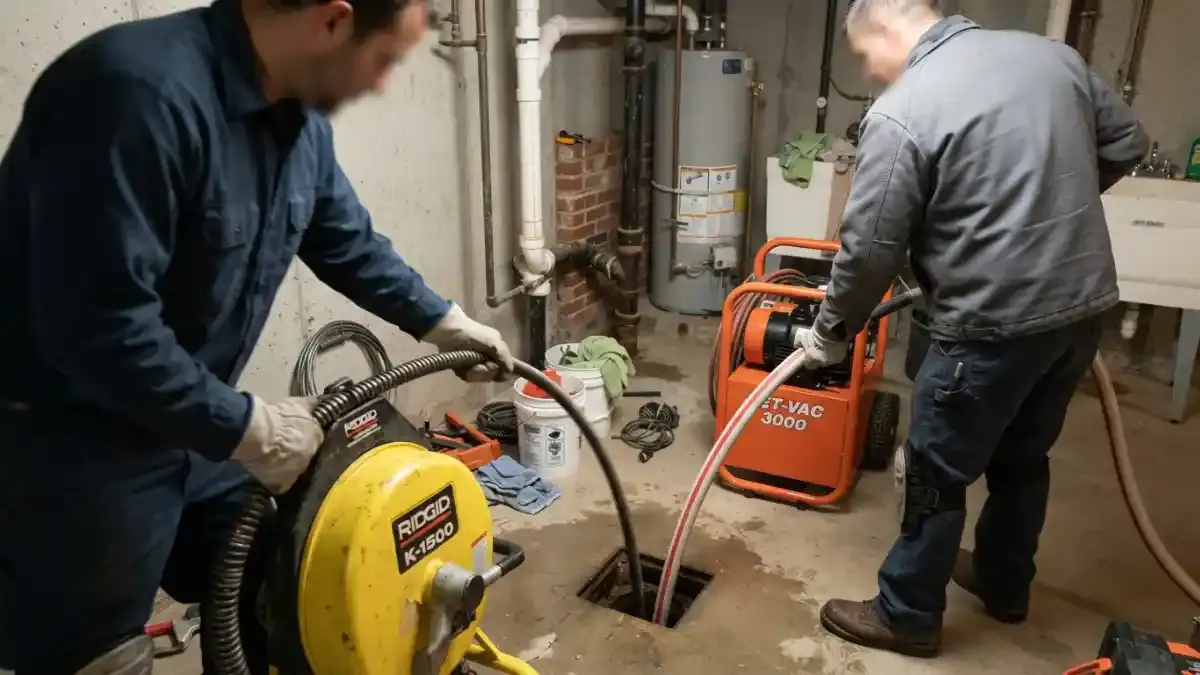
A cable machine, the tool used in ordinary drain cleaning, pushes a spinning steel line through the pipe and cuts or pokes through the blockage. A jetter feeds a flexible hose with a nozzle at the end. Water shoots out of small ports on that nozzle, some pointing back to pull the hose forward, and others angled to scour the pipe wall.
That scouring is the point. A cable often leaves a ring of grease or mineral scale clinging to the pipe, and the next soap scum or paper sticks to it. Callers who say the line clogs again every couple of years are usually describing that ring thickening. Jetting removes the buildup rather than just opening a path through it.
Jetting also washes debris out of the line instead of pushing it further along. For a kitchen line with years of grease or a main with root hairs, that can mean a longer stretch of clear pipe. It does not repair a crack or a belly in the pipe, and it will not stop roots from growing back through an open joint.
What to do if the sewer line backs up right now
A full line is already overflowing somewhere, so the first job is to stop adding to it.
Before the jetting crew arrives
- Stop all water use.That includes the washer, dishwasher, showers and toilet flushes. A jetter works faster in a line that is not still filling.
- Open the cleanout cap only if you know where it is.Do not pry it loose if the pipe is full of water, because the pressure can release a flood of sewage into the room.
- Protect people and pets.Sewage can carry germs. Wear boots and gloves if you must enter the area, keep children out, and wash your hands with soap.
- Keep electricity away.If water is near outlets, appliances or a panel, do not touch them. Call the line and tell the dispatcher what is wet.
- Call the village for a street-side check.Public Works at 847-459-2545 in business hours, or the police non-emergency line at 847-459-2560 after hours, can look at whether the main in the street is involved.
Fit
When jetting is the right call and when it is not
Jetting suits lines that are structurally sound but dirty. That includes kitchen branch lines with heavy grease, main lines with scale and sludge, and lines that need to be cleaned after a cable pass before lining or repair. It also helps clear a line that a cable could not pass, because the water can flow around obstacles.
It is a poor fit for a pipe that is cracked, crushed, bellied or broken at a joint. Water pressure can force water out of a break and wash soil from around the pipe, which makes the damage worse. A camera inspection first shows whether the pipe is sound enough, and that is why the plumber usually looks before jetting.
Older clay or cast iron pipe needs extra care. Those lines often have rough interiors, thin spots or loose joints. In those cases, a plumber may choose a gentler pass or recommend a repair before cleaning.
Jetting, cabling and repair: how to choose
Plumbers weigh the same few questions on every job. Here is the pattern.
| What you see | Likely approach | Why |
|---|---|---|
| First clog in a bathroom sink | Hand snake or small cable | A short, soft blockage does not need a jetter |
| Kitchen line slow every few months | Camera, then jet | Grease scale builds on the wall and returns after a cable |
| Main clogs every year or two | Camera, cable, then jet | Roots, scale or a sag may be behind the repeat clogs |
| Cable stops at the same spot | Camera before any water pressure | A collapse or offset could be stopping it |
| Visible crack or heavy offset | Sewer line repair | Cleaning will not fix a broken pipe |
The plumber chooses the final method after seeing the line.
Roots and grease
Roots, grease and scale: what the jetter removes
Tree roots enter sewer lines through small gaps at joints, drawn to the moisture inside. A cable with a cutter takes the large roots out, but fine root hair stays on the wall and catches paper. A jetter's nozzle can clear that hair, which is why plumbers often cable first and jet second on a root-affected main.
Kitchen lines carry cooking grease that cools and hardens into a layer on the pipe wall. Jetting with warm water can break that layer down. Mineral scale works the same way inside older iron pipes, narrowing the opening a little more every year.
Roots will grow back unless the entry point is sealed. If the camera shows roots at a joint again and again, a spot repair or a section replacement may be worth discussing. Jetting every year or two to keep a root line open is a choice some owners make, and the plumber can give you a sense of the interval after seeing the line.
Line backing up and cabling has not held?
Call (847) 281-8626 and describe what the line has been doing.
Planning
Jetting for a house, a rental or a commercial building
Property owners ask about jetting for several reasons, whether the building is in Buffalo Grove or in nearby Wheeling. Some have a repeat clog. Some want a line cleaned before they buy or sell a house. Some manage a multi-unit building with a shared stack that backs up in the lowest unit.
For a house, the plumber looks at the cleanout, the length of the run and what the camera shows. For a larger building, access to the main, the number of fixtures and how often the line fills all affect the plan. If you are comparing offers, ask what is included, whether a camera pass is part of it, and how far the hose will run.
Some callers ask whether the same work can be done as a whole-house cleaning rather than only the main. It can, if the branch lines are accessible, and the plumber can explain how the plan changes the price. If you only want a quote, describe the pipe, the history and any recent backup, and the dispatcher passes it on.
What drives the price of hydro jetting
The price is explained before work starts. These are the pieces that move it.
Where jetting fits with other sewer work
Jetting is usually one step in a sequence. These pages cover the others.
Sources
Standards and sources behind this page
The ownership note and backup contacts come from the Village of Buffalo Grove Sewer and Drainage page, which says the homeowner owns the private line to the main. The Metropolitan Water Reclamation District's guide to sewer backups lists a blocked or damaged lateral as a common cause and recommends inspecting and cleaning it.
Plumbers in Illinois are licensed through the Illinois Department of Public Health, and you can check a name on the department's license verification page. If your job involves digging, call JULIE at 811 at least 3 days before the work.
Questions we hear from homeowners
Yes. The line at (847) 281-8626 is answered around the clock, and a plumber can be sent when a sewer line is backing up at night or on a weekend. For an active backup, the first goal is to open the line, and a full jetting plan can follow the camera view.
On a sound pipe it normally does not. On a cracked, crushed or badly offset pipe, water pressure can make a break worse. That is why a camera check comes first on most jobs.
They do different things. A cable cuts or pokes through a blockage, and a jetter scours the walls clean. Many jobs use both, with the cable first on a root-heavy line.
There is no single interval that fits every house. A line with trees nearby may need it more often than one without. Ask the plumber after the camera pass what the line is telling you.
It clears root hair and the buildup roots catch on, but it does not seal the joint they entered. If roots return, a spot repair or section replacement is worth discussing.
The best access is a cleanout on the sewer line, often outdoors near the foundation or in the basement. Without one, the plumber may pull a toilet or use a roof vent, and the dispatcher explains which in advance.
No. Public Works does not cut roots or televise private lines. The line from the house to the main is the homeowner's responsibility, so call a plumber for that stretch.