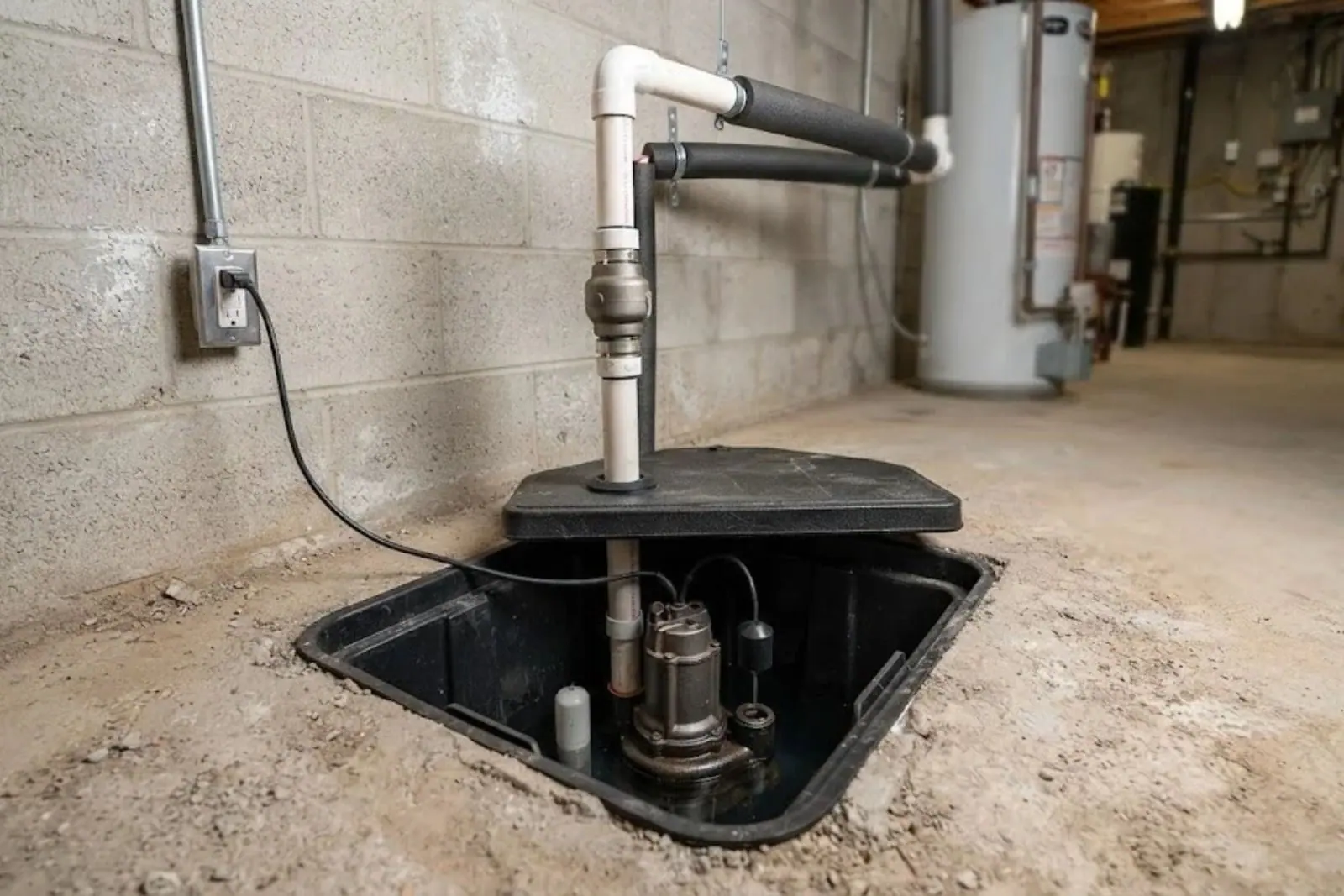
Why storms matter here
Heavy rain, Buffalo Creek and why pumps fail at the worst time
Buffalo Creek is the main flood source in the village, and Cook County's hazard mitigation plan lists federal flood declarations in 1972, 1973, 1986, 1987, 1993 and 2013, plus state declarations in April 2013 and July 2017. For a homeowner, that history means long wet stretches do happen, and a pump that sat idle for months may be asked to run for days.
FEMA says a basement floods when the primary pump fails, power goes out, or rain exceeds the pump's capacity. Each of those has a different remedy, so it helps to know which one you are facing before you call.
What to do if the sump pit is filling and the pump will not run right now
Water coming into a basement can reach outlets, a furnace and stored belongings quickly. Put safety first.
Until the plumber arrives
- Stay out of standing water near electrical items.Do not touch the pump, an extension cord or an outlet while you are standing in water. If water is near the panel, leave and call the utility.
- Check the simple things.Look at the plug, the GFCI outlet and the breaker. A tripped GFCI is a common reason a pump stops.
- Lift valuables and boxes off the floor.Move paper, electronics and stored items to shelves or upstairs.
- Do not run water in the house.Limit laundry, showers and dishwashers while the pit is full, because the drains can add to the water in the basement.
- Do not try to open the sealed lid and work on a live pump.Turn the pump's power off first or call, since an energized pump in water is dangerous.
Call call (847) 281-8626. Storm nights, weekends and holidays are answered the same way, and a same-day visit can be arranged for a failed pump.
Testing the pump you already have
FEMA's guidance gives a simple test. Do it once a year, and again before a wet season.
Pour water into the pit
Slowly add a bucket of water. A healthy pump turns on when the float rises and empties the pit.
Watch the discharge
Check that water leaves through the pipe outside and does not drain back down. A check valve on the pipe prevents backflow into the pit.
Clean the inlet screen
If the pump has a screen at the intake, clear any grit or debris away so it can draw freely.
Listen for trouble
A pump that grinds, rattles or cycles on and off in rain is warning you. FEMA suggests replacing a pump that is over ten years old or that you have never heard running.
Symptoms and the usual cause
Describe what you see and hear and the plumber can arrive with the right parts.
Pump will not start
Often a tripped GFCI, a stuck float, a failed switch or a burned-out motor. If the float moves freely and power is present, the pump is likely done.
Pump runs but the pit does not empty
A clogged discharge, a failed check valve, a frozen or crushed outside line, or an impeller worn down can all do this. Water that drains back into the pit makes the pump run again and again.
Pump runs constantly
A float stuck in the up position, a pit too small for the inflow, or a very high water table can keep it going. A pump working non-stop wears out faster.
Pump cycles every few minutes
Short cycling can come from a failing check valve, a float set too close, or water returning from a long discharge pipe.
Pump is old and quiet
A pump you have never heard run may not be working at all. A test now is cheaper than finding out in a storm.
Water rising and no pump?
Call (847) 281-8626 and ask for a plumber today. The line is open all night.
Where the discharge goes: the village's request
The Village of Buffalo Grove asks that sump discharge be disconnected from the sanitary sewer and directed to the storm sewer or onto the lawn, no more than 10 feet from the house. If you connect to the storm sewer, a permit from the village Engineering department is needed, and the village handout lists details such as a 4-inch air gap, SDR 26 PVC pipe and an 18-inch depth.
What this means for you is that a new or replaced pump should be planned with the discharge route in mind. A plumber can tell you where the current pipe terminates and whether a change is needed before you call Engineering at 847-459-2523.
Primary pump and battery backup
FEMA describes a battery backup pump as one that starts when water reaches its float switch, and some models include an alarm.
Primary pump only
- Runs on household power
- Stops when the power goes out
- Simple and low cost
- Fine if outages are rare and rainfall is moderate
Primary plus battery backup
- A second pump on its own battery
- Keeps working in an outage or if the primary fails
- May alert you when it runs
- Better for finished basements or frequent wet seasons
Whichever you choose, the discharge pipe and check valve should be sized to match.
New installation: what happens on the job
A new pit or a replacement pump follows the same broad sequence.
| Stage | What is done | What to expect |
|---|---|---|
| Assessment | Look at the pit, float, discharge and power | A plan and the price before work starts |
| Permits | Check whether a permit is needed for the work | The village requires permits for plumbing work beyond maintenance and repairs |
| Pump set | Install the pump, float and check valve | Pipe fittings sealed and tested |
| Discharge | Route water outside away from the house | Storm connection only with village permission |
| Test | Fill the pit and watch it run | You see the pump start and stop |
Ask the plumber who handles any permit paperwork before the date is set.
What changes the price of sump pump work
Replacing a pump in an existing pit is a different job from digging a new pit, so we explain the work before pricing it.
When the pump is not the whole story
If the basement is wet but the pit is dry, the water is coming from somewhere else. That could be a sewer backup through a floor drain, a leaking pipe, or seepage that has nothing to do with the pump. Our pages on basement waterproofing and sewer line repair cover those cases.
Gurgling floor drains during a heavy rain suggest the sewer rather than the sump. Stay away from that water, and read about drain cleaning if the floor drain only runs slow, because sewage-contaminated floodwater is a health risk, and ask about a check valve or a cleanable access point.
Sources used for this page
The pump test, ten-year replacement guidance and battery-backup description come from FEMA's published basement flood guidance. The flood history is from the Cook County hazard mitigation plan, and the discharge request and permit contacts are from the Village of Buffalo Grove. Plumbing work falls under the Illinois Plumbing Code (Title 77, Part 890).
Plumbers are licensed by the Illinois Department of Public Health, and its online license verification lets you check one before work starts.
The village's 4-inch air gap and pipe specifications are its own standards, and the pump testing guidance follows FEMA.
Questions we hear from homeowners
Yes. The line at (847) 281-8626 is answered 24/7. A pump that has failed with the pit filling is treated as urgent, and storm nights are when many of these calls come in.
Pour a bucket of water into the pit. The pump should turn on and empty it. FEMA recommends checking it every year.
FEMA suggests replacing a pump that is over ten years old, one you have never heard running, or one that cycles on and off in rain.
The village asks that discharge be kept out of the sanitary sewer and sent to the storm sewer or the lawn, about 10 feet from the house at most. A storm sewer connection needs a permit from village Engineering.
It is a good idea if you have a finished basement or lose power in storms. A backup pump starts when water reaches its own float switch.
It can be. A stuck float, a failing check valve or a high water table are common reasons, and a pump that never rests wears out sooner.
The village requires a permit for plumbing work beyond maintenance, servicing or repairs. Ask the plumber to confirm the requirement for your job before work starts.