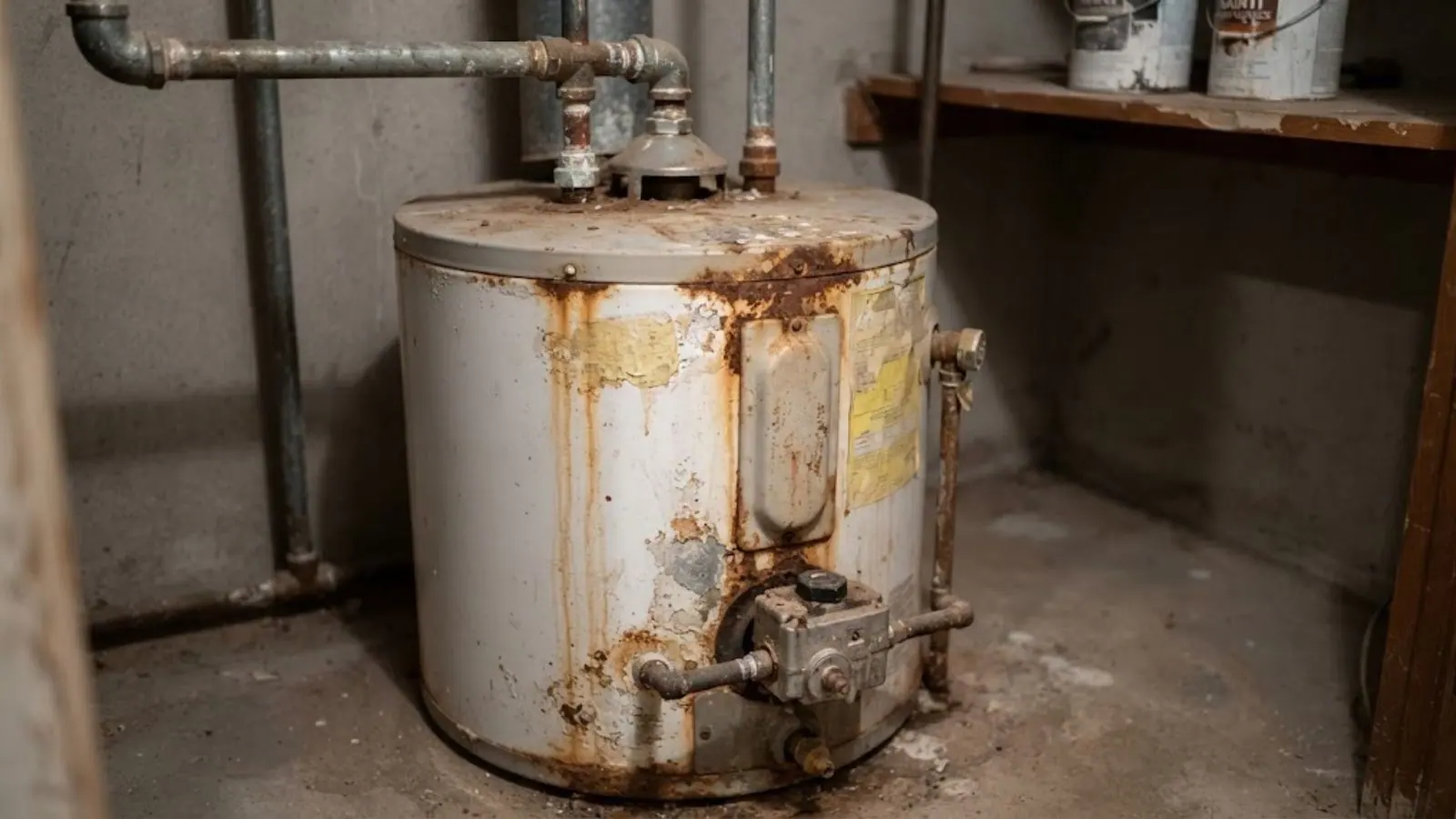
Why we do not give you a year count
You will see confident numbers online for how long a tank heater lasts. We left them out on purpose. The federal guidance reviewed here does not give one figure, and the real answer swings with water quality, installation and use.
What matters more is the condition of your unit today. Two heaters of the same age can be in very different shape, one with a clean tank and sound fittings and the other with heavy deposits and a weeping connection. A plumber looking at yours is the reliable answer.
How to find out how old your heater is
You can learn a lot in a few minutes without tools. Do this while the unit is cool to the touch around the label.
Find the rating label
Look on the side of the tank for a silver or white sticker with the model and serial numbers. It also lists the capacity and fuel type, which the plumber will ask about.
Read the serial number
Many manufacturers build the production month and year into the serial number, but the format differs by brand. Read the number to the plumber or look up the brand's decoding guide.
Check the paperwork
An old permit, an install sticker or a receipt from the last replacement can date the unit.
Note the condition
Look for rust at the base, moisture on the floor, mineral crust at the fittings and scorch marks near the vent. These tell you more than the age on its own.
Ask a plumber to assess it
Ask about the age, the condition, the relief valve and the venting. Their answer should be specific to your tank, not a generic number.
Signs a heater is wearing out
None of these proves the tank is finished, but each is a reason to have it looked at.
| What you notice | What it can mean | What to do |
|---|---|---|
| Popping or rumbling from the tank | Deposits on the bottom that trap heat | Ask the plumber about the sediment |
| Rust-colored hot water | Corrosion inside the tank or in old pipes | Test cold water too, then call |
| Water around the base | A leaking fitting or a failed tank | Shut off the cold supply and call |
| Not enough hot water | A failing element, burner or thermostat, or a heavy load | Have it tested, a repair may fix it |
| Water that runs warm then cold | Deposits or a dip tube problem | Ask for a check of the unit |
| Soot, scorch or a smell of exhaust | A venting or combustion problem | Stop using it and call right away |
A gas smell is different. Leave the building, do not touch switches or use a phone inside, and call Nicor Gas at 800-942-9727 or 911 from outside.
What hard water does inside a tank
The Village of Buffalo Grove's 2022 water quality report lists hardness between 120 and 130 mg/L as calcium carbonate. The USGS calls 61 to 120 moderately hard and 121 to 180 hard, so the reported range sits right at the edge between the two.
The USGS says heated hard water forms calcium carbonate deposits that can reduce the life of equipment. It also says the deposits lower the efficiency of electric water heaters and raise heating cost. For a Buffalo Grove homeowner, that is the reason to ask your plumber what is building up in your tank, not a reason to panic.
Not sure how old your heater is?
Call (847) 281-8626 and describe what is on the label. We will help you decide if a visit makes sense.
Flushing: what it can and cannot do
Flushing means draining some water from the bottom of the tank to carry out loose sediment. We are not going to give you a schedule, because none of the federal sources we could confirm sets one. The Department of Energy says only that periodic maintenance can help extend a heater's life.
Ask your plumber whether flushing suits your tank. On an older unit that has never been drained, a drain valve can stick or leak when it is opened. That is a case where it is safer to have a plumber do it than to try it yourself.
If you flush it yourself
Turn off the power or set a gas unit to its off or vacation setting, shut the cold supply, and connect a hose to the drain valve. Open a hot tap upstairs so the tank can drain, and run the water somewhere safe. Never drain a tank that is still hot, because the water can scald.
When to leave it to a plumber
If the drain valve is plastic and crusty, if there is any moisture at the base, or if the unit has never been serviced, hand it off. A water heater repair visit can include checking the valve, the relief valve and the fittings together.
Simple care that costs little
These steps are within reach of most homeowners, and each one lowers the chance of a surprise.
- Check the setpoint.The Department of Energy recommends 120 degrees F for most homes, which also reduces scald risk.
- Look at the base.A quick look once a month catches a damp spot before it becomes a flooded floor.
- Keep the area clear.Do not store paint, gasoline or rags near a gas heater, and keep the vent clear.
- Test your alarms.Carbon monoxide alarms belong within 15 feet of every sleeping room, and the CPSC says to put them on every level.
- Ask about the relief valve.Have the plumber test the temperature and pressure relief valve during any visit.
- Write down the date.Mark the installation date and the last service on the tank or in your records.
Repair, replace or plan ahead
If a tank is leaking from its body, it is finished and the next step is water heater replacement. If the problem is a part, such as an element, thermostat or valve, repair may be the smarter move. The plumber should explain which one it is and why.
If your unit is old and you would rather replace it on your own schedule, do that before it fails at night. A planned swap lets you pick the size and fuel, and a tankless water heater is an option to compare. Either path needs a village permit, so build that into your plan.
Where the facts on this page come from
The water hardness figures come from the Village of Buffalo Grove's 2022 water quality report, and the hardness classes come from the USGS. The setpoint and maintenance guidance comes from the Department of Energy. The carbon monoxide points come from the Consumer Product Safety Commission and 430 ILCS 135/10.
Gas leak steps follow Nicor Gas guidance.
Plumbers in Illinois are licensed by the Illinois Department of Public Health, and you can check any license on the IDPH online verification page.
The 120 degree setpoint and sizing guidance follow Department of Energy standards, while age and flushing questions are left to the label and the maker's manual.
Local note
What Buffalo Grove homeowners should know
Buffalo Grove buys Lake Michigan water through the Northwest Water Commission, and the village's 2022 report lists hardness of 120 to 130 mg/L. Newer reports may differ, so check the latest one or test your tap. If you see scale on faucets, a softener can reduce what reaches the tank, and Wheeling and Arlington Heights homeowners get water through the same commission.
A water heater replacement in the village needs a permit, with an emergency replacement applied for within 24 hours. Repairs and servicing do not need one, so a flush or valve check is a lighter step than a swap.
Questions we hear from homeowners
There is no single figure we can stand behind. Condition, water quality and installation matter as much as age. Read the date code and have a plumber check the unit.
Find the rating label on the tank and read the serial number. Many brands encode the month and year of manufacture, but the format varies. A plumber can decode it.
Ask your plumber. The Department of Energy says maintenance can extend life, but we do not set a flushing interval. An older unit with a stuck drain valve is better left to a professional.
The village's 2022 report lists hardness between 120 and 130 mg/L. That sits at the edge of the USGS moderately hard and hard classes. Check the latest report or test your own tap.
The USGS says deposits from heated hard water can reduce the life of equipment and lower the efficiency of electric heaters. Ask your plumber what has built up in your tank.
The Department of Energy recommends 120 degrees F for most households. It reduces scald risk.
Yes. The village requires a permit for a replacement, and the plumber handles it. Repairs and servicing do not need one.