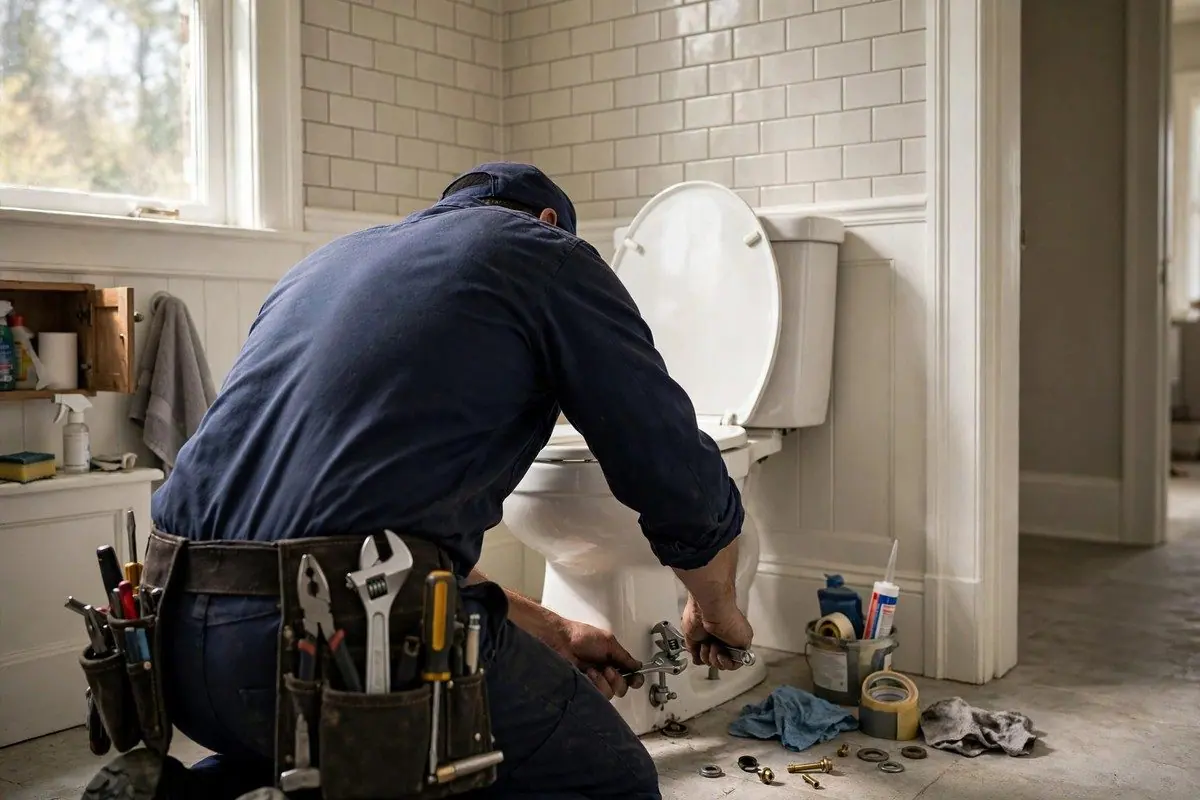
Why a toilet runs when nobody is using it
A toilet tank is a small, simple machine. When you flush, the flapper lifts, water drops into the bowl, the flapper seats again, and the fill valve refills the tank until a float tells it to stop. A running toilet means one of those parts is not finishing its job.
The sound can be a hiss, a trickle, or a toilet that restarts by itself every few minutes. That last one, sometimes called ghost flushing, nearly always means a slow leak from the tank into the bowl. Because the leak is silent, it can waste water for weeks before anyone notices.
The 10-minute dye test
EPA WaterSense recommends a dye test to find a flapper leak. It takes almost no tools and gives a clear answer.
How the test works
- Remove the tank lid.Set it somewhere safe on a towel so it does not chip.
- Add a few drops of food coloring to the tank.Dark colors show up best. Do not flush.
- Wait 10 minutes.Leave the toilet alone and stay out of the bathroom.
- Look in the bowl.If color has appeared, the flapper is not sealing, and replacing it should stop the leak.
- Flush to clear the dye.Do this when you are finished so the tank does not stain.
EPA also suggests checking for silent leaks like this once a year, and it puts the typical life of a flapper at about five years.
Part by part: what fails and what you can see
If the dye stays out of the bowl, work through the other parts inside the tank.
| Part | What goes wrong | What you see or hear |
|---|---|---|
| Flapper | Worn, warped or coated with scale, so it no longer seals | Dye reaches the bowl, the tank refills now and then |
| Chain | Too short and holds the flapper open, or too long and gets caught beneath it | Constant trickle that stops when you jiggle the handle |
| Fill valve | Fails to shut off, or lets water through slowly | Hissing, water rising to the top of the overflow tube |
| Float | Set too high or damaged so water never shuts off | Water running into the overflow tube |
| Overflow tube | Water level set above the tube's rim | A steady stream pouring into the tube |
| Tank to bowl seals | Cracked or aged gaskets | Water on the floor around the base |
A quick test is to lift the float by hand. If the running stops, the problem is the float setting or the fill valve, not the flapper.
Replacing a flapper yourself
Flapper replacement is one of the easier plumbing repairs, as long as you buy the right size and style. Turn off the supply valve at the wall, flush to empty the tank, then unhook the old flapper from its ears and chain. Take it with you to the store so you can match it.
Hook the new flapper in place, set the chain with a small amount of slack, turn the water back on, and run the dye test again. If dye still reaches the bowl, the valve seat the flapper rests on may be rough or pitted, and that is a good moment to stop and call.
Why scale matters
USGS notes that mineral deposits form on fixtures and appliances where water is hard. The village's 2022 water quality report lists hardness between 120 and 130 mg/L as CaCO3, so it is reasonable to expect some buildup in tanks over time. Scale on the flapper or seat is a common reason a new part still leaks.
Toilet still running after a new flapper?
Call (847) 281-8626 and a plumber can find the cause and explain the price before work starts.
What a running toilet does to your water bill
A toilet that runs steadily can send a lot of water down the drain without making any noise. Because all of your water passes through the village-owned meter, a leak like this shows up as higher usage rather than as a puddle.
If your usage has jumped and the toilets pass the dye test, the loss may be elsewhere. Leak detection can find leaks behind walls and under slabs, and a plumber can also check the supply line and the shutoff valve at the wall during a toilet repair visit.
What to do if the toilet is overflowing right now
A running toilet that is also rising toward the rim is an overflow, and it needs a different response.
While you wait
- Close the supply valve.Turn the oval handle behind the toilet clockwise until it stops.
- Lift the tank lid and push the flapper down.This stops water from entering the bowl while you work.
- Do not flush again.Another flush adds more water to a bowl that cannot drain.
- Put towels down and call.Use the 24/7 line at (847) 281-8626 if water reaches the floor or the bowl will not drain.
If clear water is on the floor but the toilet seems fine, the supply line or a tank seal may be leaking. That is a plain repair, though water on the floor near an outlet is worth turning the power off for.
When it is more than a tank part
A toilet that runs and also clogs often has a partial blockage beyond the bowl. A toilet that rocks, leaks at the base or has a loose tank needs new seals or a reset. A very old toilet may be cheaper to replace than to keep repairing, and that is a choice a plumber can lay out for you, along with an upfront price.
If several fixtures act up together, the issue may be in the drain rather than the toilet itself. A drain that backs up from the lowest fixture is a job for drain cleaning, not a tank part.
Where the guidance comes from
The dye test, the yearly silent-leak check and the flapper lifespan come from EPA WaterSense home maintenance guidance. The hardness figure comes from the village's 2022 water quality report and the USGS hardness classes.
Illinois plumbers are licensed by the Illinois Department of Public Health, and its online license verification page is the way to check a plumber before they work in your home.
The dye test and flapper timing follow EPA WaterSense guidelines, which are the standards most manufacturers write their own instructions around.
Local note
What Buffalo Grove homeowners should know
The village owns the water meter, so a silent leak in a toilet shows up in your recorded usage. Public Works takes water quality questions at 847-459-2545 on weekdays.
The plumbers who answer our line also serve Wheeling and Lincolnshire, so the same running-toilet checks apply across the area. Replacing a flapper or fill valve is repair work, and the village requires permits for plumbing other than maintenance, servicing or repairs.
Questions we hear from homeowners
That is usually a slow leak from the tank into the bowl past a worn flapper. The water level drops slightly, then the fill valve tops it up.
Add a few drops of food coloring to the tank, do not flush, and wait 10 minutes. Color in the bowl means the flapper is leaking.
EPA WaterSense puts it at about every five years. Replace it sooner if it fails the dye test.
Some adjustments, like the chain, can be made with water on. Replacing parts is easier with the supply valve closed.
It depends on the leak, and the amount can be large over a month. Check your water bill and the dye test to see whether a toilet is behind a jump in usage.
Not usually, but it wastes water and can hide a bigger problem. If water reaches the floor or the bowl will not drain, call the 24/7 line.
The village owns the meter, and every gallon that passes through it is recorded as used. A leaking toilet counts as water used, so fixing it quickly keeps your usage down.