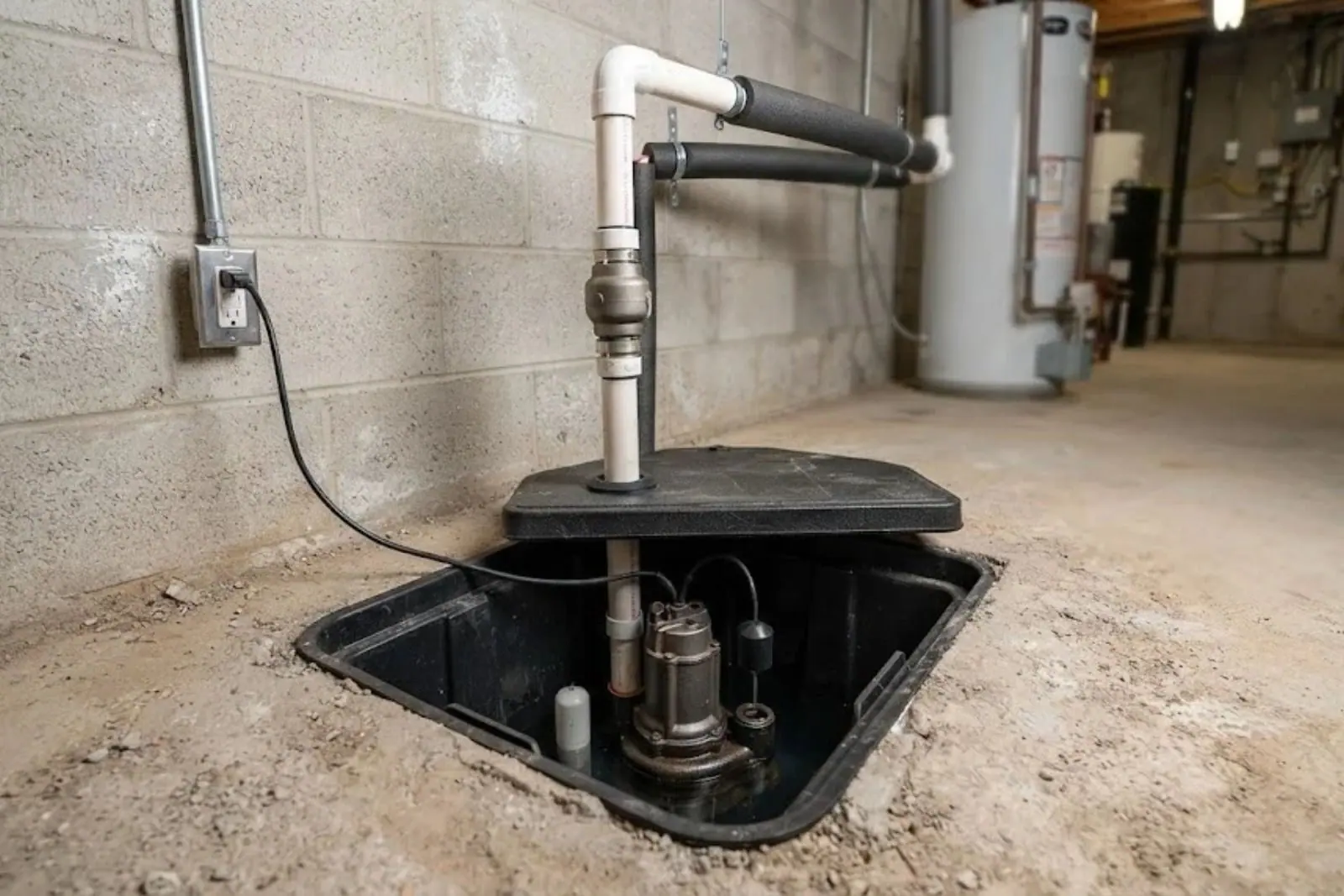
Five checks to run before you call anyone
Work through these in order. Each takes a minute or two, and the first three explain most pumps that look dead.
Look at the power
Make sure the pump's plug is seated in the outlet. Basement outlets often share a circuit, so a tripped breaker or a tripped GFCI (the outlet with test and reset buttons) can silence the pump. Reset it once. If it trips again right away, stop and call, because a repeat trip near water is a safety problem.
Find out whether the whole house lost power
Storms cause pump failures and power failures at the same time. If the lights are out, only a battery backup pump will run. Keep your hands, tools and extension cords away from standing water near any outlet.
Do the bucket test
FEMA's home guidance is simple: pour a bucket of water into the pit and the pump should turn on. If it starts and empties the pit, the motor is alive and the earlier problem was probably power or a sticky float. If nothing happens, keep going.
Look for a stuck float
A float that is wedged against the pit wall, tangled in its own cord or sitting in silt will never rise. Only touch it if the pump is unplugged and the floor around you is dry. Free it, plug the pump back in and repeat the bucket test.
Listen for a hum with no water moving
A motor that hums but moves nothing often has a jammed impeller, a blocked intake screen or a clogged or frozen discharge pipe. Unplug it and stop there. Reaching into a pit with the pump live is how people get hurt.
What the symptom usually means
Use this as a quick map. It does not replace looking at your own pit, but it shows which problems are a home fix and which need tools.
| What you see or hear | Likely cause | Home fix or call |
|---|---|---|
| Nothing at all, no hum | No power, tripped GFCI, dead switch or burned-out motor | Check power and reset once, then call if still dead |
| Hum but no water moves | Jammed impeller, blocked screen or frozen discharge | Unplug, then call |
| Pump starts but pit does not drop | Failed check valve, airlock or discharge blockage | Call, the pump may be running dry or backing up |
| Float rises and nothing starts | Worn float switch or wiring fault | Call, switches are cheap to replace but need testing |
| Pump runs, then stops with water still high | Motor overheating or float hanging | Free the float if safe, otherwise call |
| Pump is silent during storms but works in dry weather | Power loss or a switch that sticks | Ask about a battery backup pump |
Never test a pump while standing in water.
When the pit is filling and nothing works
This is the point where DIY ends. Lift valuables, boxes and electronics off the floor, and keep everyone away from outlets, the panel and any water that is near them. If water is rising toward electrical equipment, do not wade in to fix anything.
Call (847) 281-8626 and tell the dispatcher what you see: pit level, whether the pump hums, and whether the power is on. We can send a plumber who handles sump pump repair and replacement and can explain the price before any work starts.
Pit filling and the pump will not start?
Call the 24/7 line at (847) 281-8626 and a plumber can be on the way.
What a plumber does at the pit
A good visit starts with finding out why the pump failed, not just swapping it. The plumber tests the float, checks the cord and plug, clears the intake screen, and looks at the check valve on the discharge pipe. That valve keeps pumped water from flowing back into the pit.
FEMA advises replacing a pump that is over 10 years old, has never been heard running, or turns on and off repeatedly in rain. If yours falls into one of those groups, a new pump often costs less than repeated emergency visits.
The final step is to test the new setup with a bucket of water and to check where the discharge ends up. Price depends on pump type, how deep the pit is, whether a new check valve and float are needed, and the hour of the call.
Keep the pump from failing again
A few small habits catch most failures before the next storm.
- Test it twice a year.Pour a bucket of water into the pit at least once a year. The pump should start and clear it.
- Clean the intake screen.Debris on the screen makes the motor work harder and shortens its life.
- Look at the discharge pipe.Make sure it is attached, sloped away from the home and clear at the outlet.
- Ask about a battery backup.FEMA notes that basements flood when the primary pump fails, the power goes out or rain exceeds capacity. A backup pump starts at the float and some models sound an alarm.
- Lengthen downspout extensions.Moving roof water farther from the foundation gives the pump less to handle.
If the basement stays damp even with a working pump, the answer may be drainage work rather than a new pump. That is a job for basement waterproofing, which a plumber can explain after seeing the walls and floor.
Where the pump should send the water
The Village of Buffalo Grove asks that sump pump discharge be disconnected from the sanitary sewer and directed to the storm sewer or onto the lawn, no more than 10 feet from the house. Connecting to the storm sewer needs a permit from the village's Engineering office at 847-459-2523.
The village handout also lists installation details such as a 4-inch air gap. If your pump still drains into a floor drain or a sewer line, ask a plumber to look at it during any repair visit.
After the pit is working again
Check the floor and walls for wet spots, and dry anything that got damp as quickly as you can. Wet carpet and cardboard hold water and grow mold if left. If the water came from the sewer rather than the sump, treat it differently and call us right away.
Insurance rules vary. FEMA notes that most homeowner policies do not cover flooding, while some cover limited water damage, so ask your insurer what yours includes before you need it.
Where the steps on this page come from
The bucket test, the 10-year guideline and the battery backup notes come from FEMA's sump pump and basement flood mitigation guidance. The discharge rules come from the Village of Buffalo Grove sump pump handout and its Sewer and Drainage page.
Illinois Plumbing Code (77 Ill. Adm. Code 890) defines a sump pump as a pump that removes storm, subsoil and clear water from a sump. Before hiring anyone, you can confirm a plumber's license on the Illinois Department of Public Health verification page.
Local note
What Buffalo Grove homeowners should know
Buffalo Creek is the village's main flood source, and the Cook County hazard plan lists federal flood declarations in 1972, 1973, 1986, 1987, 1993 and 2013, plus state declarations in April 2013 and July 2017. In practice, that means a pump that stalls in a heavy-rain year is not a rare worry here, so test yours before storm season.
The village grew quickly in the 1970s, and its first homes were single-story, many without basements. If your home has a crawl space or a shallow basement, a plumber can tell you how the pit and discharge were set up.
For nearby towns, see the pages for Wheeling and Arlington Heights.
Questions we hear from homeowners
The most common reasons are a power outage, a tripped GFCI, a stuck float or a pump that is simply worn out. Storms strain a pump the most, so an aging unit tends to fail right when it is needed.
Pour a bucket of water into the pit. The float should rise, the pump should start, and the water level should drop. If the pump does not start, run through the five checks above and call if it still will not run.
FEMA suggests replacing a pump that is over 10 years old, has never been heard running or cycles on and off in rain. A pump near that age that has begun to act up is usually better replaced than repaired.
Yes. A backup pump starts when water reaches its float, and some models sound an alarm. It only helps if the battery is kept charged and the unit is tested, so ask the plumber how to check it.
The village asks that sump discharge be disconnected from the sanitary sewer and directed to the storm sewer or lawn, no more than 10 feet from the house. A storm sewer connection needs a permit from the village Engineering office.
Yes. The line at (847) 281-8626 is answered around the clock, and storm nights are when most pump calls come in. Tell the dispatcher about the pit level and whether the power is on.