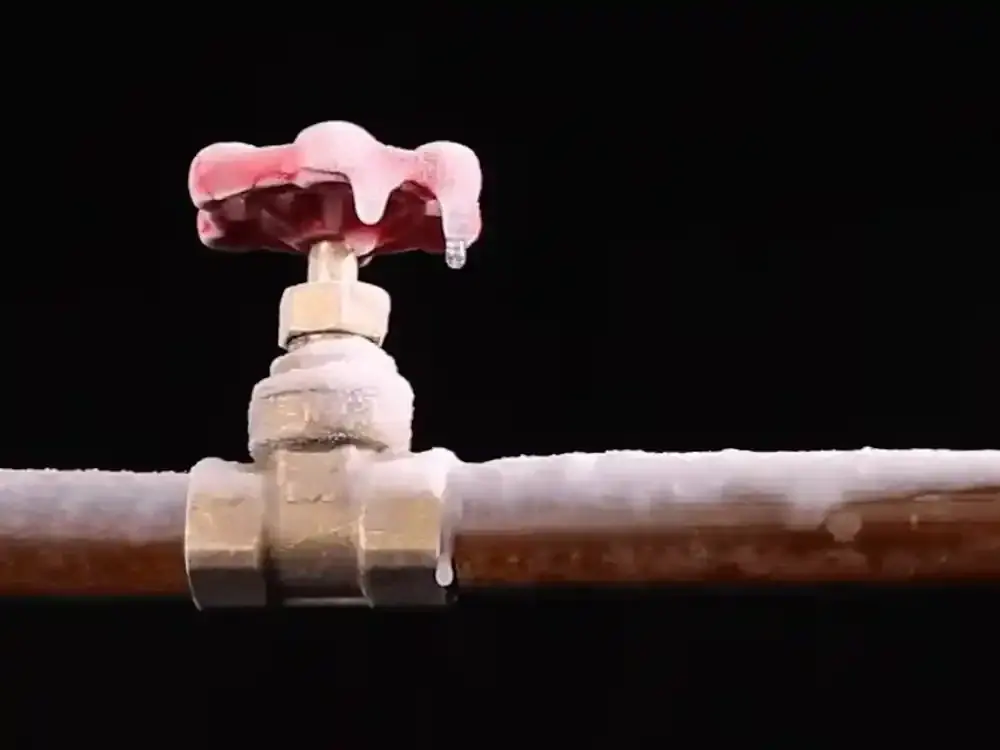
How to tell a pipe is frozen and not just slow
The classic sign is a faucet that gives only a trickle, or nothing at all, when the weather has been well below freezing. If the cold tap and the hot tap both fail, the freeze is probably upstream of the water heater. If only one fails, the ice is somewhere on that single line.
Frozen water expands, and the pipe walls take the strain. A pipe can look fine from the outside and still hold ice that is pushing against a weak spot. That is why a slow thaw matters more than a fast one.
- Only a trickle from one faucet, or no water at all
- Frost or a visible bulge on an exposed pipe
- A cold draft or a chilled wall near the sink
- Other faucets in the house still run normally, which points to a single frozen line
Thawing a frozen pipe: the safe order of operations
Work from the faucet end toward the blockage. Heat applied near open water has somewhere to go, while heat applied near the middle of a sealed section traps steam and pressure.
Do these in order
- Keep the faucet open.Leave the tap on the frozen line turned on. As ice melts, water needs a way out, and the moving water also helps melt the rest.
- Find the likely spot.Look along exterior walls, in the garage, under sinks on outside walls, and where the water service enters through the foundation. Those are the usual freeze points.
- Apply gentle heat.Use a hair dryer, a heating pad wrapped around the pipe, hot towels, or a space heater set well away from anything that can burn. Move the heat along the pipe instead of parking it in one place.
- Keep going until pressure is full.A thin stream means ice is still in there. Stay with it until the faucet runs at normal strength.
- Check every other faucet.If one line froze, another may be partly frozen. Open each tap in the house and look for a weak flow.
- Call a plumber if it will not thaw.If you cannot find the frozen section, cannot reach it, or the pipe is behind a finished wall, stop and call. Pushing harder is how a frozen pipe becomes a burst pipe.
The heat guidance above follows the American Red Cross advice on frozen pipes. The point of every step is slow, even warming.
Frozen pipe you cannot reach?
Call (847) 281-8626 any hour and a plumber can talk you through what to check before anyone comes out.
Heat sources: what is safe and what is not
Not every heat source is a good idea near a pipe. This table sorts the common ones by how they behave around plumbing and around your house.
| Method | Verdict | Why it matters |
|---|---|---|
| Hair dryer | Safe if kept dry and moving | Gentle, controllable heat. Keep the cord and the dryer away from any standing water. |
| Heating pad wrapped on the pipe | Safe | Steady low heat over a longer stretch of pipe. |
| Hot towels | Safe | Slow and messy, but no fire or electrical risk. Re-wet them in hot water as they cool. |
| Space heater | Use with care | Set it away from flammable things, never leave it unattended, and keep it clear of damp floors. |
| Blowtorch or other open flame | Never | Fire risk inside walls and cabinets, and it can overheat a pipe or joint in seconds. |
| Propane or kerosene heater | Never | Open flame and combustion fumes indoors. Carbon monoxide is a separate danger. |
| Charcoal stove | Never | Open flame and carbon monoxide risk. |
Gentle heat and an open faucet are the common thread in guidance from the American Red Cross.
If a method on this list makes you nervous, it is the wrong method. A plumber has tools that heat a pipe in a controlled way, and calling costs less than a house fire or a flood.
Where pipes freeze in Buffalo Grove houses
The same few spots fail again and again. Pipes in exterior walls, runs through an unheated garage, lines in a crawl space, and the point where the water service comes through the foundation all sit close to cold air. A kitchen sink on an outside wall is a frequent first casualty.
If your home has no basement, look at utility closets, slab-level wall cavities and any crawl space before assuming the problem is inside the living area. Homes in the village vary a lot in age and layout, so the safest habit is to learn where your own water enters and which walls face north.
Outdoor hose bibs deserve their own check. A bib that was left connected to a hose can freeze back toward the house, and the damage may not show until the weather warms and the pipe thaws on its own.
What to do if a pipe has already burst
A thawed pipe sometimes reveals a split that the ice was plugging. If water is spraying or pooling, treat it as an active leak and act in this order.
While you wait for help
- Shut off the main water valve.Know where it is before you need it. Turn it fully closed, then open a low faucet to drain the lines.
- Turn off electricity to wet areas.If water is near outlets, appliances or the panel, do not step into standing water. Cut power only if you can reach the breaker without getting wet.
- Move belongings.Lift rugs, boxes and electronics out of the path of the water.
- Call the 24/7 line.Dial (847) 281-8626. A split pipe is a job for burst pipe repair, and the sooner the water is controlled the less drywall and flooring is affected.
If you smell gas at any point, leave the building. Do not use switches or phones inside, and call Nicor Gas at 800-942-9727 or 911 from outside.
When thawing is the wrong move
Some situations call for a plumber instead of a hair dryer. A pipe inside a finished wall or ceiling cannot be warmed safely without opening it. A bulging or cracked pipe may fail the moment it thaws.
A frozen line between the street and the house is also outside what a homeowner should try. If the whole house has no water and every faucet is dry, the freeze may be in the underground run, and that is a job for water service line repair. Digging requires a JULIE locate first, and the village has its own permit rules for water service repairs.
What a plumber brings
A plumber can trace the frozen section, apply controlled heat, and test the line for splits as it thaws. If water still disappears after the thaw, the next step is leak detection, which pinpoints a hidden break without tearing open every wall.
If a line freezes repeatedly in the same spot, the real answer may be rerouting or insulating that run, or in older systems a larger project such as repiping. That conversation starts with a call, and the price is explained before work begins.
Keeping the same pipe from freezing again
Prevention is mostly about air. Insulate pipes in attics, basements, crawl spaces and the garage, and use pipe sleeves or UL-listed heat tape on runs that cannot be moved. Open cabinet doors under sinks on outside walls so house air reaches the pipes.
During a hard freeze, let a cold tap drip so water keeps moving. Keep the thermostat steady, and if you travel, do not set the heat below 55 degrees Fahrenheit. Before winter, drain and close the inside valve to each hose bib and leave the outside bib open.
- Insulate exposed pipes and use UL-listed heat tape where needed
- Open cabinet doors on cold nights
- Let a cold tap drip during a deep freeze
- Keep the heat steady, never below 55 F when away
- Close and drain inside valves to hose bibs, leave outside bibs open
Where the advice on this page comes from
The thawing, heat-source and prevention guidance follows the American Red Cross page on frozen pipes. The village facts come from Buffalo Grove's own pages and the Cook County hazard mitigation plan, and the gas safety line follows Nicor Gas guidance.
Pipe work in Illinois is regulated. The Illinois Department of Public Health licenses plumbers under the Illinois Plumbing License Law, and you can check any plumber's license on the IDPH online verification page. Digging for a service line repair requires a call to JULIE at 811 at least 3 days ahead.
The no-open-flame rule and the gentle-heat guidance follow Red Cross standards for frozen pipes, so treat them as the safe floor for anything you try yourself.
Local note
What Buffalo Grove homeowners should know
Cook County's hazard mitigation plan lists extreme cold events in 2019, 2021 and 2022. That is a reminder that deep freezes are a repeat risk here, so a winter plan for your pipes is worth making before the next one arrives.
The village distributes Lake Michigan water through its own mains, but the service line from the curb stop to your house is the homeowner's. A freeze or break on that private side is yours to repair, so know where your main shutoff is. Buffalo Grove Pro Plumbing's dispatch line routes to plumbers who work in Wheeling, Deerfield and the surrounding area as well.
Questions we hear from homeowners
Yes. A hair dryer is one of the safer options. Keep the faucet open, keep the dryer moving along the pipe, and keep the cord and the dryer away from any water.
No. The Red Cross specifically warns against a blowtorch, kerosene or propane heater, charcoal stove or any other open flame device. Fire inside a wall is a bigger problem than a frozen pipe.
It depends on how long the ice plug is and how much of the pipe you can reach. Keep applying gentle heat until the faucet runs at full pressure. If nothing improves after a reasonable effort, call a plumber.
If you see leaking, yes. Closing the main valve limits damage if the pipe splits as it thaws. If there is no leak, you can leave the supply on while you thaw with the faucet open.
Look for water on the floor, wet drywall, a hissing sound, or a meter that spins when everything is off. Hidden breaks inside walls can be found with leak detection equipment.
Yes. The line at (847) 281-8626 is answered 24 hours a day, including nights, weekends and holidays. A plumber can walk you through the first moves while help is on the way.
The village owns the mains and the meter. The homeowner owns the service line and the curb stop area on the private side. A freeze on that private run is the homeowner's to repair.