What hardness actually is
Hardness is the amount of dissolved calcium and magnesium in the water. According to the USGS, it is measured in milligrams per liter as calcium carbonate. Soft water is 0 to 60 mg/L, moderately hard is 61 to 120, hard is 121 to 180 and very hard is anything above 180.
The everyday trouble is what hard water leaves behind when it is heated or evaporates. Minerals come out of the water and form scale, and that is what you see on faucets and shower doors.
What to do if a softener or water heater starts leaking
Scale and salt can hide a slow leak for a while, so treat any wet floor near the equipment as a real problem.
- Shut the supply.Close the valve feeding the softener or water heater, or the main shutoff if you cannot reach it.
- Cut the power.Unplug the softener, and switch off the water heater at its breaker before touching anything wet.
- Smell gas? Leave.Go outside, then call Nicor Gas at 800-942-9727 or 911 from outside.
- Call the 24/7 line.Describe where the water is coming from so the right plumber arrives with the right parts.
Reading the Buffalo Grove numbers
Here is how the village's reported range lines up with the USGS classes.
| Measure | Value | What it means |
|---|---|---|
| Village 2022 report, minimum | 120 mg/L as CaCO3 | Top of the moderately hard class |
| Village 2022 report, average | 130 mg/L as CaCO3 | In the hard class |
| USGS moderately hard | 61 to 120 mg/L | Some scale over time |
| USGS hard | 121 to 180 mg/L | More noticeable scale and soap effects |
| Your own tap | Test it | Home plumbing and conditions can differ from the report |
The 2022 report is the most recent one this page uses. Newer reports may carry different numbers, so check the latest one from the village or test your tap.
The practical takeaway is that Buffalo Grove households are likely to see some scale, though you may not see much. The best evidence is what your own fixtures show.
Signs hard water is affecting your home
You do not need a lab to spot it. Look around the house for these.
- White crust on faucets and shower heads.This is calcium carbonate left behind as water dries.
- Spots on glasses and dishes.Dishwasher results get cloudy and glasses carry chalky spots.
- Soap that will not lather well.The USGS lists soap scum among the effects of hard water.
- Reduced flow at a shower head.Deposits narrow the openings, and in pipes they can narrow the passage as well.
- Water heater noise.Rumbling or popping from the tank can point to deposits at the bottom.
If you see several of these, a test and a conversation with a plumber is a reasonable next step.
What scale does to pipes and water heaters
The USGS says heated hard water forms calcium carbonate deposits that can reduce the life of equipment. It also reports that deposits lower the efficiency of electric water heaters and increase heating cost, and that they can narrow pipes and reduce flow.
A water heater is the first place this shows up, because heating drives the minerals out of the water. If your tank is noisy or slow to recover, ask the plumber about deposits during a water heater repair visit. A water softener installed upstream reduces what reaches the heater.
Seeing scale and not sure why?
Call (847) 281-8626 and describe the spots. We will tell you whether a test or a softener visit makes sense.
What a softener does and what it needs
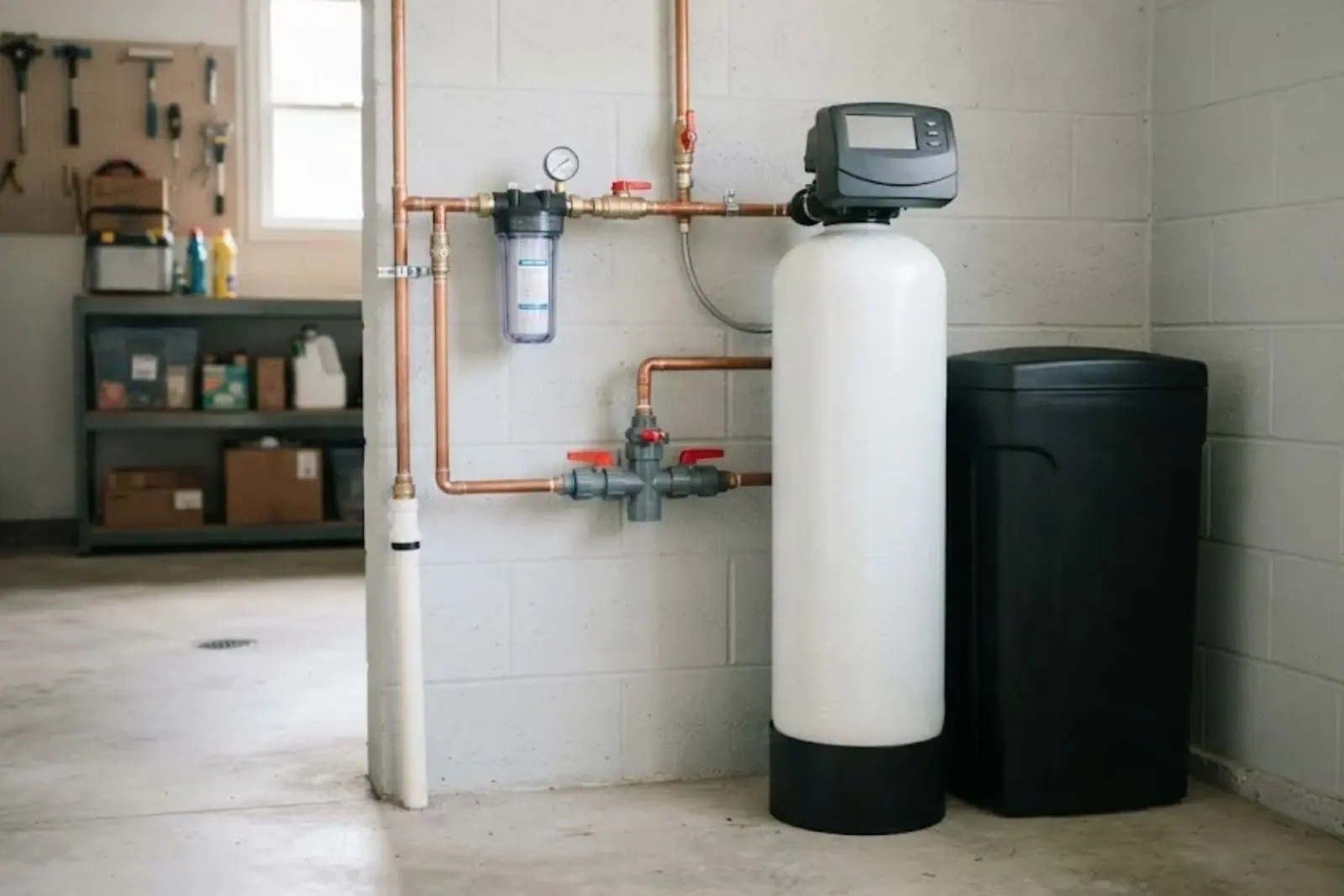
A cation-exchange softener is the common type for a house. The EPA WaterSense guide to home water treatment describes how it works.
What it does
- Removes excess calcium and magnesium from the water
- Reduces scale on fixtures and appliances
- Protects the water heater from the worst deposits
- Is installed where the main line enters, after the main shutoff
What to plan for
- Salt that has to be refilled to regenerate the resin
- Water used during each regeneration cycle
- Discharge of salts to a drain, which affects local water quality
- A check of local rules, since some jurisdictions restrict softeners
These tradeoffs are from the EPA WaterSense guide. A good installer will describe them for your home, including where the drain line goes and which fixtures the softener serves.
How a softener installation is approached
Our page on water softener installation covers the job in detail. This is the short version.
Test the water
Measure the hardness at your own tap. That number sets the size of the unit and how often it regenerates.
Pick the location
The unit needs a spot near the main line, a drain, a power outlet and enough floor space for the brine tank. A basement utility area often fits.
Plan the drain and bypass
The regeneration water has to go somewhere that is allowed to take it. A bypass valve lets you isolate the softener for service.
Decide which water to soften
Many homes leave an outdoor spigot on unsoftened water. The plumber can set that up when the unit is tied in.
Set up and test
The unit is programmed, the system is flushed and the plumber checks for leaks and checks the water after it runs.
Alternatives and add-ons
Some homeowners try a shower head filter or descale a kettle with vinegar. Those handle a fixture or an appliance, not the whole house. A scale reducer or a conditioning device is a different technology from a softener, and we do not claim it works the same way.
If hot water is the only concern, an annual check of the water heater may be enough. For a whole-house solution, compare a softener with a drinking water filter, since they do different jobs. A softener does not make water filtered, and a filter does not remove hardness.
Safety and rules that apply to the install
Call 811 (JULIE) at least 3 days before digging if any outdoor work is involved, such as a new drain line. Ask the installer where the regeneration drain line will go and whether that is allowed at your address.
A softener installation touches the water supply and the drain, and plumbing work in Illinois is regulated by the Illinois Plumbing Code. Ask the installer to explain the permit step for your address.
Where the facts on this page come from
The hardness figures for Buffalo Grove come from the village's 2022 water quality report. The hardness classes and the effect of scale on heaters and pipes come from the USGS. The softener description comes from the EPA WaterSense guide to home water treatment products.
Plumbers in Illinois are licensed by the Illinois Department of Public Health, and you can check a license on the IDPH online verification page. JULIE is the state one-call service for locating underground utilities.
Local note
What Buffalo Grove homeowners should know
Buffalo Grove buys Lake Michigan water from the Northwest Water Commission, which is supplied by Evanston, and the village distributes it through its own mains. The village's 2022 report lists hardness between 120 and 130 mg/L, and it lists chlorine as the disinfectant. Do not assume a number from another town applies to your tap.
You can call Public Works at 847-459-2545 with water quality questions on weekdays. If you live near Lincolnshire or Deerfield, your supplier and numbers may be different. Check your own town's report instead of using the village's figure.
Questions we hear from homeowners
The village's 2022 report lists hardness between 120 and 130 mg/L. That is at the top of the USGS moderately hard class and the start of the hard class. Check the latest report or test your tap.
It depends on what you see. Scale on fixtures, spotted glasses and a noisy water heater are common reasons homeowners choose one.
A cation-exchange softener removes excess calcium and magnesium. It regenerates with salt and uses water in the process.
The USGS says heated hard water forms deposits that can reduce the life of equipment. It also lowers the efficiency of electric heaters.
The EPA WaterSense guide says that some jurisdictions restrict softeners because of the salts they discharge. Ask the installer about rules for your address.
The village publishes an annual water quality report. Public Works can answer questions at 847-459-2545 on weekdays.
The USGS says deposits can narrow pipes and reduce flow. A plumber can check for it if your pressure has dropped.